

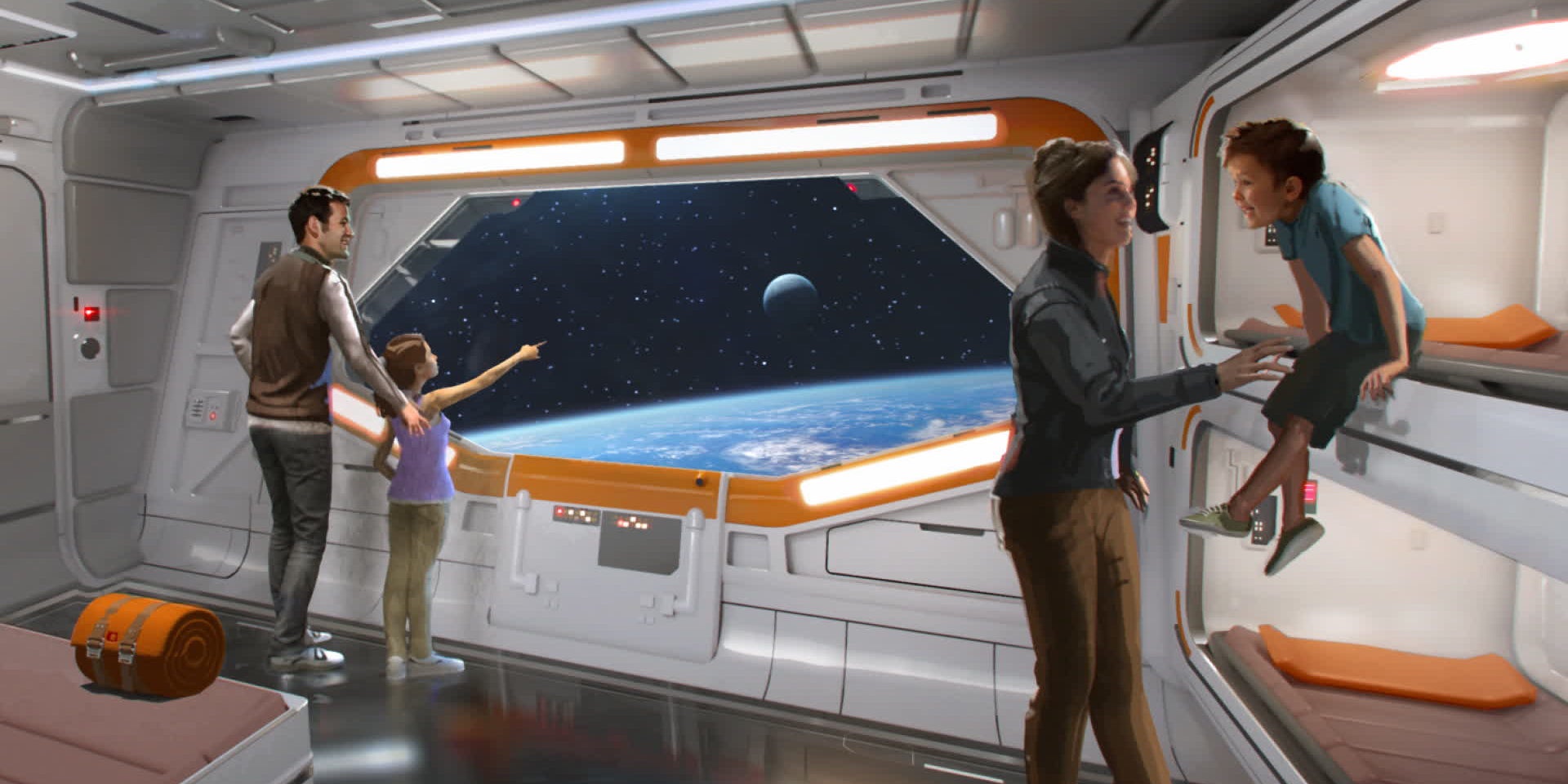
You know, sometimes you just want to get away. A little vacation. Maybe to a galaxy far, far away. But what if that galaxy feels less like a dream destination and more like… well, a windowless bunker? Reports are circulating about the Star Wars: Galactic Starcruiser, once pitched as the ultimate immersive experience, now facing a rather un-galactic fate.
The news is pretty clear: that billion-dollar “Star Wars Hotel” isn’t beaming guests aboard for a two-night role-playing adventure anymore. Instead, the facility has reportedly been repurposed. It’s now serving as office space and temporary living quarters for new Disney hires. A somewhat less glamorous mission than saving the galaxy, wouldn’t you say?
For those who followed the saga of this ambitious project, this pivot isn’t entirely shocking. The Galactic Starcruiser opened with massive hype, promising an unprecedented, fully immersive, live-action role-playing (LARP) experience. Guests were meant to live out their own Star Wars story over two days, confined to a “ship” with character interactions, themed dining, and even “missions” that influenced their journey. It sounded, on paper, like a dream for any dedicated fan. But then the price tag hit.
We’re talking about upwards of $5,000 per person for a mere two-night stay. Think about that for a second. For that kind of money, you could book a fairly luxurious cruise through the Mediterranean, or stay at a high-end resort for a week. This wasn’t just a theme park hotel; it was marketed as a theatrical production you were part of.
So, why did a concept with such potential end up as corporate housing? The facts point to a few key issues. First, the cost was simply too high for most, even the affluent who typically frequent Disney’s higher-end offerings. Value matters, even to those with deep pockets. Second, the creative direction reportedly missed the mark for many long-time fans. The experience was heavily tied to the sequel trilogy characters and an original, somewhat generic setting, rather than drawing from the beloved original trilogy. People wanted to see Luke, Han, and Leia, or visit iconic locations like Mos Eisley, not new characters in an unfamiliar setting that many felt alienated from.
Critics also pointed out that the “immersive” nature often felt more restrictive than freeing. Guests were essentially trapped on a spaceship with no real windows to the outside world — only digital screens simulating space. Some prominent online critiques detailed experiences where the interactivity felt forced, or key elements of the show were blocked by structural poles, despite the premium price. It created a feeling of being in an “underground car park” rather than soaring through hyperspace. Disney’s recent track record with Star Wars content, with a perceived lack of cohesive storytelling and vision across films and shows, certainly didn’t help generate the overwhelming fan excitement needed to sustain such a high-priced, niche experience.
Now, it’s not all bad news. From a business perspective, converting the Starcruiser into offices and temporary housing is a pragmatic move. It means a billion-dollar asset isn’t just sitting idle, bleeding money. Disney can utilize the space for its operational needs, providing practical solutions for employee relocation and workspace in a growing company. It’s a resourceful adaptation, transforming a failed luxury venture into functional corporate infrastructure. It shows a degree of practical thinking, even if it comes after a significant miscalculation in the market.
Ultimately, the Star Wars: Galactic Starcruiser was an ambitious experiment that highlighted the delicate balance between innovation, fan expectations, and price point. It’s a stark reminder that even with the most powerful IP in the galaxy, you still have to deliver perceived value. And sometimes, what you promise as an out-of-this-world adventure might just end up being someone’s new cubicle.